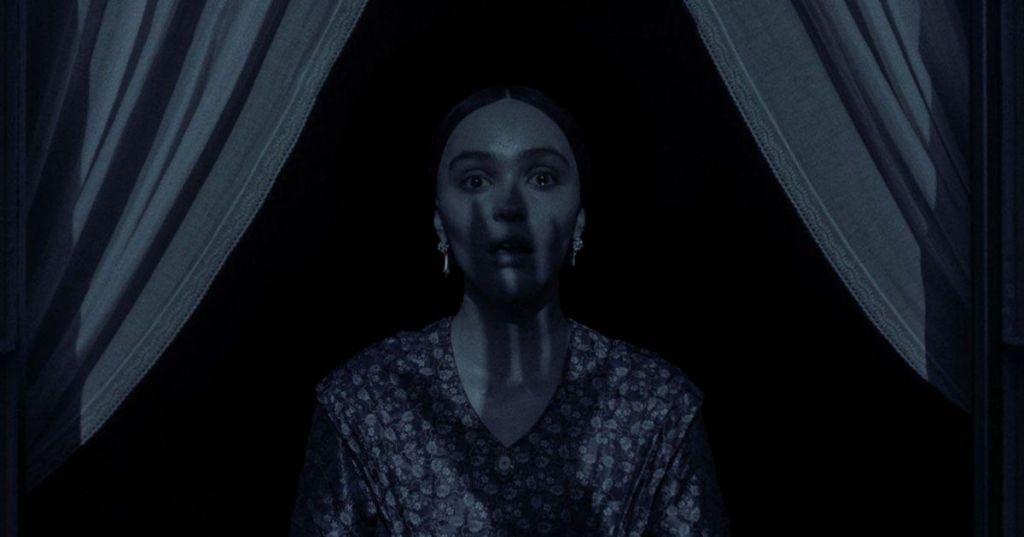
Keep away from me – I am unclean! — Lily Rose Depp as Ellen Hutter, Nosferatu
The first time I watched Robert Eggers’ Nosferatu, I was immediately overwhelmed with a sense of dread— not because the movie was bad in any way, but because the things Ellen Hutter were going through felt eerily similar to a lot of things I and many other women go through on a daily basis.
Decades of horror and gothic novels and movies have depicted vampirism as an allegory for homosexuality and eroticism (Dracula, Carmilla, and the like) which I believe is still true to an extent. However, we must also consider that vampirism specifically can be used as an allegory for the life-long battle of escaping one’s abuser. Even in Bram Stoker’s Dracula or Sheridan le Fanu’s Carmilla, the vampires manipulate their victims or attack them while they’re sleeping in order to get their blood, which can be an allegory for sexual assault. Is the act of letting a vampire drink your blood try consensual if you were manipulated into it? This idea coincides with the depiction of vampirism in Robert Eggers’ Nosferatu quite well.
Most horror and fantasy movies do not shy away from sexual assault, it’s used to shock the audience and to depict the callousness of the characters in the face of it serves as a reminder that such things were “normal” back in the day. Eggers’ Nosferatu does an amazing job in showing the abnormality of it and the different ways in which people react to sexual assault. He highlights that there is nothing erotic about Count Orlok’s actions, Mary Beth McAndrews perfectly puts it in her article when she says “this is violent male obsession with owning the female body through any means necessary.”
Ellen’s assault has been affecting her personal relationships. We can first see this when she becomes riddled with anxiety at the thought of Thomas leaving her alone. As her safe person, if he leaves, Ellen believes that Count Orlok will come back for her, this is shown when she says “From our love, I became as normal” which means she believes that her relationship with Thomas saved her, that she is doomed without it.
While he is gone, Ellen suffers from nightmares and visions, her trauma resurfaces as she feels unsafe without him with her. Thomas’ spot on her bed becomes occupied with memories of the Count. When Thomas comes back, he tells Ellen how right she was but their relationship becomes strained as Thomas is traumatized by his time with the Count. When he initiates sex with her, she yells at him to stay away from her and that she is “unclean”. When they finally do have sex, the scene could be interpreted in two ways: disturbing or powerful.
It is powerful because Ellen sees this act as standing up against the count, a declaration that she does not fear him as can be seen when she says “let us show him our love”. However, it can also be disturbing because it shows us that even in such an intimate moment with her husband, the Count and his abuse loom over her, every part of this act serves as a reminder of what the Count did to her.
This feeling is very common amongst survivors, the feeling of having your autonomy stripped from you in such a violent manner and the judgement that comes from society, especially as a woman is bound to make us feel unclean, and any intimate act afterwards becomes a battle in its own right. When we get assaulted, we are told that what we were wearing was provocative, that it was our fault for going out so late at night, that we shouldn’t be on dating apps to being with because who knows what kind of men are on there. Any attempt at coming forward is met with blame and rejection. If you’re religious, you’re told your purity has been taken from you, that you are now impure and are worth less as a woman because of it.
I’m bringing up religion because Nosferatu is set in the early 19th century, where religion still played a large role in society. Purity culture started with religion. The idea that getting raped devalues a woman stems from the belief that she is now impure, has been sullied, that she is not worthy of marriage as women were expected to be virgins up until their wedding. The men that rape these women rarely get punished, they’re instead coddled and told that it’s not their fault they were tempted by the mere existence of a woman even if said “woman” is a prepubescent child.
This belief transcends the past, it lives in our present and continues to thrive with the rise of redpilled alpha male content that push the idea that men are creatures driven by their dicks, that we women must accommodate them and cover up so as not to tempt them.
I’m sure many of us remember being told to get changed as children or teenagers because a specific uncle or family friend was coming over. The responsibility to not get raped or assaulted falls on us women and girls since the moment we are born. Why is it that we have to change when you shouldn’t be inviting perverts into our homes to begin with?
Ellen has been tormented by Count Orlok since her childhood: when she was young, vulnerable, and easy to manipulate. When she confided in her father, he chalked the things she was telling him down to the nightmares of a very imaginative child, a common experience for victims of child sexual assault. When her father finds Ellen naked and convulsing on the garden floor, he blames her for what happened.
Evil, he said… He would have sent me to someplace… I shan’t go… — Lily Rose Depp as Ellen Hutter, Nosferatu
Her father’s reaction depicts the attitude around sexual assault at Ellen’s, and arguably, today’s time. Victim-blaming is always expected when a woman comes forward, society’s inherent need to protect a man’s reputation over a woman’s life is always disappointing but never shocking.
No matter how young we are, it is always our fault as women for tempting a man. The idea that we have somehow become “unclean” after our assault is ingrained into us since the moment we are socialized to the point where we are taught to be ashamed of what was done to us. The blame put on us as if to exonerate any and all actions of the man who actually committed the crime. This is also shown in the movie, with Count Orlok blaming Ellen for assaulting her.
O’er centuries, a loathsome beast I lay within the darkest pit ‘til you did wake me, enchantress, and stirred me from my grave. You are my affliction. — Bill Skarsgård as Count Orlok, Nosferatu
Count Orlok manipulated and abused Ellen since she was a child. He weaponized her “specialness” and made her believe that he was her only confidante, a tactic used by many pedophiles and abusers today in order to isolate their victims and gain their trust. This leads to victims blaming themselves and not coming forward as adults as many courts have ruled in favor of rapists in cases like this, saying that the child consented to the act, conveniently pushing aside the fact that a child is not capable of consenting to sex.
Yet as an adult, Ellen is aware that she didn’t deserve anything that happened to her when she says “I was but an innocent child” during her confrontation with the Count. Despite being terrified of him, Ellen still found the power within herself to stand up to him and reiterate that his perversion is not her fault, an important message that is actively kept from victims.
My one problem with the movie is that Ellen dies at the end. I don’t like that the movie basically tells us it’s on Ellen to kill the monster, no matter the cost of it, which in this case is her life, but I believe that scene can be interpreted as a metaphor for how awful the process of coming forward as a victim is. The movie may use Ellen’s death to symbolise her liberation from the Count’s torment but that makes me uncomfortable. It pushes the narrative that true liberation comes from self-sacrifice, that justice and survival are mutually exclusive which should not be the case.
This highlights a broader issue of how the media portrays survivors, either as people who become consumed by their trauma or as something to be erased for the conclusion of the story. Justice should never come at the victim’s expense. Both in Ellen’s and our world, seeking out justice feels like a death sentence. We are expected to be perfect victims or else our rape and abuse is simply viewed as a twisted act of divine retribution. The perfect victim is the beautiful, kind, straight, virgin, white, dead woman. Anyone else simply had it coming according to our society and justice system.
© 2025 C. H. Gökdemir. All rights reserved.
 Cece: Unfiltered
Leave a comment